
Працюємо в усіх регіонах України
Працюємо в усіх регіонах України
15.01 2026
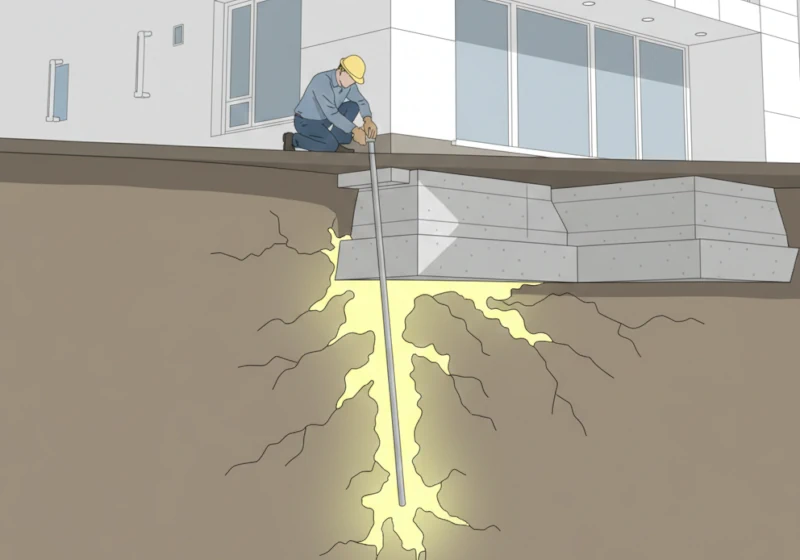
Chemical soil consolidation is a general term used to describe various methods of strengthening base soils, which are united not by the material, but by the chemical reaction of hardening and compaction of the soil in the process. Various chemical reagents, resins, and solutions of several components can be used. Another unifying factor for all the variety of technologies is drilling wells to introduce reagents into the soil.
Each of the methods has its own characteristics and strengths, so let’s briefly consider each of them.
Geopolymer injection – due to a chemical reaction, they expand, filling cavities, form a strong bond with the soil and harden. The composition of the geopolymers themselves is a trade secret, depending on the manufacturer and technical conditions they may differ. Various resins and gels can be used as a base. To ensure a chemical reaction, the solution is introduced in a two-component version – fixative + hardener. The undoubted advantage of the technology is the speed of the chemical reaction and effective protection against moisture. Of all existing technologies, it is polymerization that allows you to achieve the greatest accuracy. This is necessary not only for stabilizing foundations, but also for lifting and leveling the foundation (returning to its original position) with high accuracy.
Polymerization also includes the resinization of soils (the reverse is also true), since only resins can be used as a polymer material. Synthetic resin solutions (there are several options here) and a hardener reagent are used as the basis of the injected solution, which provides a chemical reaction (expansion, binding and hardening).
Silicate injection includes a number of different technologies, which are united by the main component of the injected solution – sodium silicate (liquid glass). Depending on the technology, the composition of the solution may differ in additional components. Depending on the task and type of soil:
Only one type of solution can be used, which is injected, displacing water from the soil, filling voids and hardening naturally.
Two solutions can be injected sequentially, the first as a base for filling (fixing agent), and the second (hardener) – which provides an accelerated chemical reaction.
There are also “exotic” versions of the technology, which are rarely used due to their complexity, cost and the availability of effective alternatives (polymerization).
Special injectors, electrodes and cathodes, are installed in the working area to pass current through the soil (into which the solution is introduced). Thus, an accelerated chemical reaction is ensured.
The second component is not a hardener solution, but carbon dioxide. It is supplied under pressure and contributes to the effective mixing of the solution and its distribution.
Today, both gas and electric silicate are rarely used. With the development of the chemical industry, more effective one- and two-component solutions for injection silicate allow achieving similar results with lower costs. This was also facilitated by competition from geopolymer injection, which allows achieving better performance while being able to use the technology with a wider range of problem soils.
The method includes two technologies:
Cold bituminization – in principle, it is similar to silicate treatment with a single-component solution, and the main difference is the presence of bitumen in the solution (instead of sodium silicate) as a base. Also, special emulsifiers are added to the solution for a chemical reaction. Bitumen fills voids in the soil, sticking to it and hardening.
Hot bituminization – the technology is most often used in mining industries, when it is necessary to fill cracks and cavities in the rock. Unlike cold bituminization, a high-density bitumen solution is used. It is supplied in a molten (heated) state and expands and hardens when solidified. This technology is not new, very specialized and not widely used.


