
Працюємо в усіх регіонах України
Працюємо в усіх регіонах України
31.12 2025
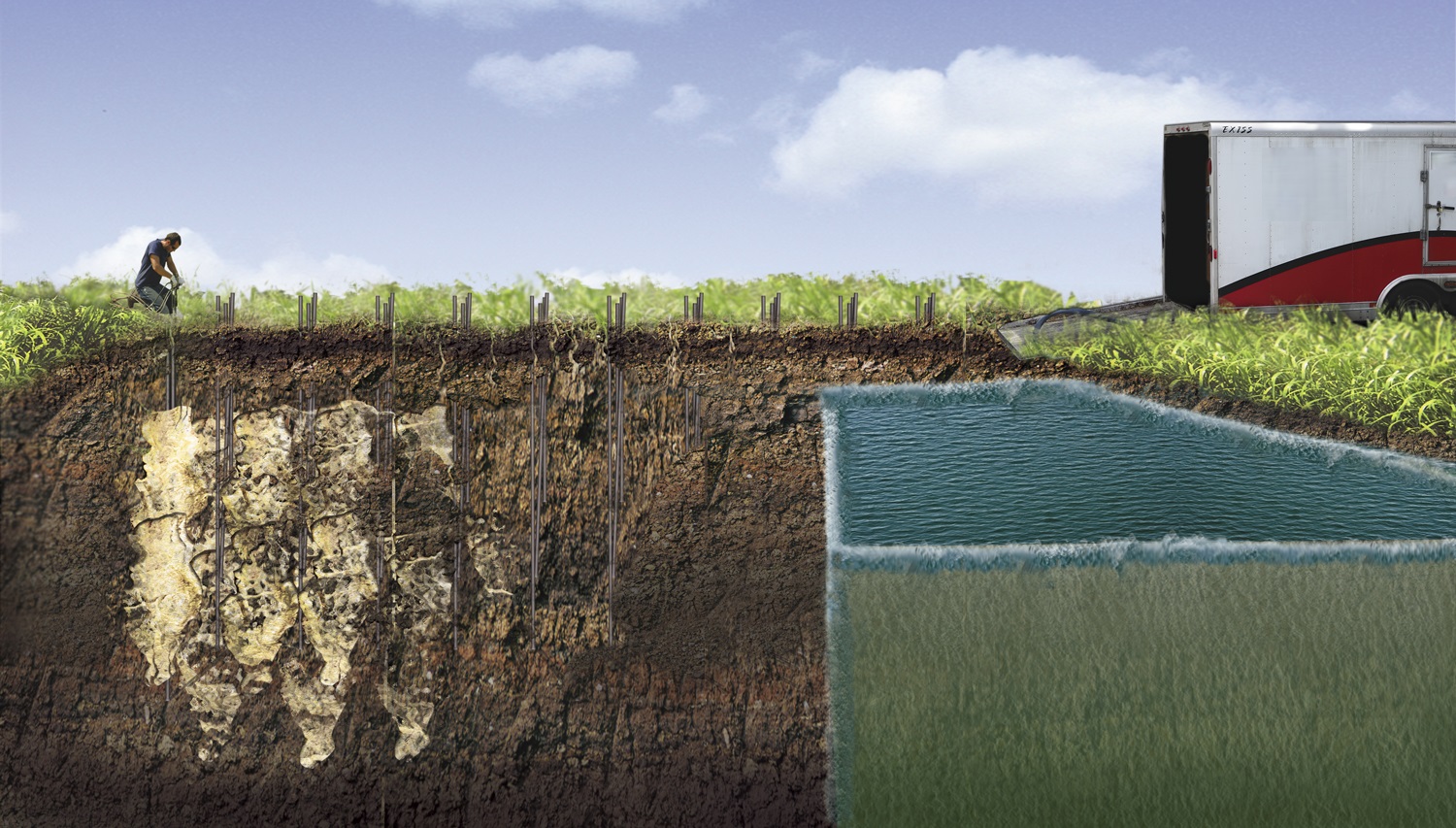
Water is one of the most paradoxical elements of the engineering environment. It is the basis of life, but at the same time remains the main “invisible destroyer” of structures and territories. Infiltration — the process of water penetration through the soil, pores, cracks and material contacts — has long been perceived as a natural background with which “one must come to terms”. Modern engineering practice proves that infiltration can and must be controlled.
For coastlines, excavations, underground structures and built-up areas, water infiltration becomes a risk factor comparable in importance to seismic effects or corrosion. If this process is not controlled, water begins to establish its own rules — slowly but inevitably.
Infiltration becomes a problem not when water is present, but when it works against the structure. Main scenarios:
Coastlines and Riparian Zones
Continuous lateral inflow of water causes soil liquefaction, loss of bearing capacity, slope slippage, and deformation of retaining structures. Often, the failure begins not from the water side, but beneath the structure.
Excavations and excavations
External infiltration leads to rising groundwater levels, flash floods, erosion of the foundation, and disruption of construction schedules. Drainage in such conditions is a temporary measure and does not eliminate the root cause of the problem.
Underground and semi-underground structures
Parking lots, pumping stations, technical floors, basements. Water does not penetrate in an open stream, but through micropores and structural joints, gradually reducing the durability of concrete and reinforcement.
Industrial and logistics sites
Saturation of soils with moisture leads to subsidence of slabs, deformation of rail tracks and disruption of the geometry of technological equipment.
An unobvious fact: weak but constant infiltration is more dangerous than short-term flooding, as it changes the physical and mechanical properties of soils in the long term.
Classic engineering solutions are well known:
However, each of these methods has limitations:
A controversial but fundamental point: there is no universal hydro barrier. An engineering solution should always start with an understanding of the infiltration mechanism, not with the choice of material.
The modern approach considers a hydro barrier not as a rigid wall, but as an engineering zone with predefined properties:
In this context, modification of the soil massif becomes key, not just isolating the structure from water.
GeoResin працює на перетині геотехніки, хімії та будівельної механіки. Підхід компанії ґрунтується на ін’єкційних технологіях, які дозволяють формувати гідробар’єри безпосередньо в масиві ґрунту, без масштабних земляних робіт.
It is not about “filling cracks”, but about creating spatially controlled zones with specified parameters of water permeability and strength.
Basic principles:
An unobvious advantage: such hydrobarriers do not age like membranes, as they become part of the soil massif.
Injection hydro barriers are effective if:
There are also limitations:
The scientific nature of the GeoResin approach lies precisely in the fact that the technology is not offered “blindly”. Each solution is based on an analysis of hydrogeology, the stress-strain state of the soils and the customer’s goals.
The real practice of using hydro barriers demonstrates:
A controversial but honest conclusion: a hydro barrier does not replace drainage, but makes it manageable and predictable.
Infiltration control is not a fight against water, but an engineering dialogue with it. Modern construction is increasingly choosing the path of environmental adaptation, rather than rigid resistance. In this sense, hydro barriers are not just a technology, but an element of a new philosophy of construction in difficult conditions.
GeoResin works in the niche of engineering solutions, where accuracy, demonstrability and long-term results play a key role. Without loud promises, but with support for the physics of processes and the experience of implemented facilities.
If water has started to interfere with the operation of your facility, it is not a sentence, but a signal for engineering analysis. Each situation is unique, but manageable solutions exist.
We will help you understand, assess the risks and choose the best path – from consultation to the implementation of an engineering solution.
Seek professional help when water exceeds acceptable limits.


